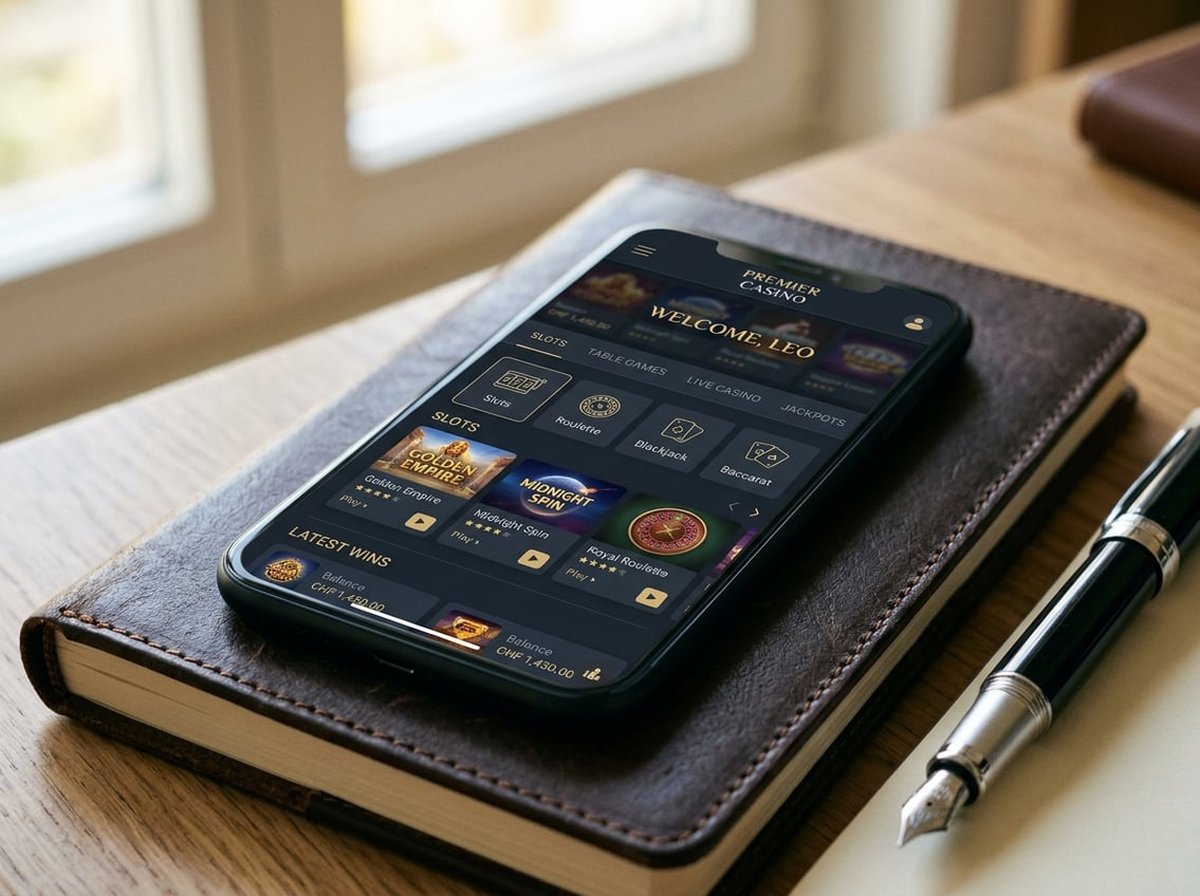
Three deployment models
AU-facing casinos reach mobile players through three main deployment models, each with distinct trade-offs.
Mobile web (responsive site). The most common model. The casino's main website is engineered to render appropriately on mobile browsers, with layout, controls, and game clients adapted for small-screen use. Players access via Safari, Chrome, or Firefox — no download, no installation. This model works uniformly across iOS and Android and is what most Australian players actually use.
Progressive Web App (PWA). A mobile web casino with additional capabilities that let the site behave like an installed application — home-screen icon, full-screen mode without browser chrome, offline capability for cached assets, and push notifications on Android. iOS support for PWAs is more limited but improving. PWAs sit between web and native in complexity and player experience.
Native applications. Downloaded Android APK files or, more rarely, iOS applications distributed outside the App Store. Native apps offer the most polished experience — offline capability, native gestures, deeper device integration — at the cost of installation friction and platform restrictions.
The distribution of these models across AU-facing operators skews heavily toward mobile web. Approximately eighty percent of operators serve their mobile players via responsive web sites, another fifteen percent add PWA capabilities, and the remaining five percent offer downloadable applications for at least one platform.
iOS versus Android: the platform divergence
Apple's App Store and Google's Play Store have quite different policies on real-money gambling applications, and these policies have shaped what AU casino apps can and cannot do on each platform.
Apple App Store permits real-money gambling apps in principle, but requires operators to hold a licence recognised by Apple in each jurisdiction the app serves. For AU-facing offshore casinos, this is generally unworkable — the offshore licences Apple recognises for other jurisdictions do not extend to Australia, and no Australian licence is available for online casino operators. As a practical matter, iOS users are almost universally routed to Safari-based mobile web rather than a native app.
Google Play Store allows real-money gambling apps in specific jurisdictions where the operator is licensed. Offshore casinos serving Australia typically cannot list in the Australian Play Store, but Android's sideloading capability allows them to distribute APK files directly from their own domains. The player downloads the APK, allows installation from an unknown source, and installs the app. This works but requires more technical steps than App Store downloads.
The practical implication for players is that iOS and Android users of the same casino may have substantially different platform experiences. iOS is essentially always a mobile web experience; Android may be mobile web, PWA, or sideloaded native depending on the operator.
What good mobile execution looks like
A well-executed mobile casino platform, whatever its underlying deployment model, exhibits specific characteristics observable to any prospective player during a five-minute pre-signup evaluation.
The cashier is functional on mobile. Deposit and withdrawal flows work within the mobile viewport, all form fields are accessible, and payment method selection is not obscured. Sites where the cashier only really works on desktop are surprisingly common and represent a significant operator-side failure.
The game lobby filters at small screen sizes. With three thousand titles in a typical library, unfiltered browsing on a mobile screen is unusable. Working filters — by studio, by game type, by feature, by jackpot status — are what makes the library discoverable. Sites lacking mobile lobby filtering are effectively unusable for anything but repeat play of a memorised title.
Search indexes game names. If searching "Book of Dead" returns matching titles, the search implementation is reasonable. If it returns nothing or returns unrelated results, the search index is broken.
Live chat is accessible without disrupting active play. Well-designed chat opens in a side panel or slide-up drawer that overlays without displacing the game. Poorly-designed chat pushes players off the current page or opens a modal that eats the whole screen.
Bonus terms are readable. The full terms and conditions for a bonus should render on a mobile screen at a legible size without pinch-zoom. If they don't, the operator has made a choice about what they want the player to focus on.
These five characteristics together are a fair proxy for the overall investment the operator has made in mobile. A site clearing all five has likely made real technical investment; a site failing three or more is running mobile as an afterthought to a desktop-first product.
Native app-specific considerations
For the small share of AU-facing operators offering native Android APKs, additional considerations apply. The APK file should be downloaded from the operator's own primary domain, not from a third-party mirror. The URL should use HTTPS. Where the operator publishes a SHA-256 hash of the APK file, verifying the downloaded file's hash against the published value confirms the file has not been tampered with in transit. This is standard software distribution practice and worth doing for any real-money application.
Permissions requested by casino APKs should be scrutinised. Legitimate casino apps typically request internet, storage, and possibly camera access (for KYC document upload). Requests for contacts, SMS, or accessibility services are red flags — legitimate casino operations do not need these permissions and their presence suggests either overreach or, in worst cases, malware distributed under a casino brand.
Auto-update mechanisms are worth understanding. Sideloaded APKs cannot use the Play Store update system, so operators typically implement in-app update prompts that download replacement APKs directly. This works, but requires trusting the operator's update mechanism as much as the initial installation. Reputable operators have visible, well-documented update flows; less reputable ones may push updates without clear communication about what has changed.
Battery and performance implications
Mobile casino play has meaningful battery and performance implications that vary by game category. Pokie play with animated bonus features is one of the more battery-intensive mobile activities, comparable to sustained mobile gaming on graphics-heavy titles. Live dealer play adds continuous video streaming, which is more battery-intensive still. Traditional table games (blackjack, roulette without live video) are much less demanding.
A one-hour session of live pokie or live dealer play on a modern smartphone typically consumes fifteen to twenty-five percent of battery capacity, depending on screen brightness and connection quality. This is worth planning around, particularly for sessions on the go — being locked out of an active session by a depleted battery is a specific failure mode worth avoiding.
Performance degrades gracefully on older devices for most modern casino platforms, but some game clients — particularly the Evolution live dealer clients and certain graphics-heavy pokies — have minimum hardware requirements below which the experience is markedly worse. Sites that publish minimum device specifications are being helpful; sites that don't leave players to discover incompatibility through poor performance.
Bonuses on mobile: usually the same, sometimes not
Bonus offers are almost universally identical across desktop and mobile at any given casino. The wagering requirements, cashout caps, game contribution weightings, and other terms attach to the account rather than the platform. What occasionally varies is mobile-specific promotional offers — some operators run mobile-only bonuses aimed at customer acquisition on the mobile channel, typically small no-deposit bonuses or free spin offers.
These mobile-only bonuses tend to have similar economic characteristics to standard no-deposit bonuses at the same operator: modest headline value, meaningful wagering requirements, cashout caps limiting realistic upside. They are worth taking selectively if the terms are reasonable, but the mobile-only framing does not itself change the underlying economics. A high-wagering mobile-only bonus is not more valuable than the same terms on desktop.
Site selection remains the primary determinant of experience quality at any online casino australia operator, regardless of whether the player predominantly uses mobile or desktop. Mobile-specific factors add a layer of consideration but do not override the basic operator-quality analysis.
Security considerations specific to mobile
Mobile-specific security considerations reduce mostly to two categories: the security of the connection between the device and the casino, and the security of the device itself.
Connection security is handled through TLS (HTTPS) at all reputable operators. Any casino not using HTTPS for both the main site and the game client is disqualifying — this is 2010s baseline security and there is no legitimate reason to be missing it in 2026. Beyond TLS, players on public Wi-Fi should consider a VPN, less for legal reasons (ACMA blocking is trivial to bypass without a VPN) than for standard Wi-Fi security reasons.
Device security matters because mobile devices carry more account credentials than desktop devices typically do. A modern smartphone with saved passwords for a casino account, a linked payment method, and a KYC-verified identity is functionally a wallet — losing it, or having it compromised, has real financial consequences. Biometric locks, remote-wipe capability, and strong device passcodes are worth setting up on any phone used for real-money casino activity.
The security fundamentals of any online casino australia platform — TLS everywhere, biometric authentication where offered, session timeout on inactivity, single-device or trusted-device restrictions — apply equally to mobile and desktop, but the practical exposure on mobile is often larger because the device travels with the player. Operators that offer session timeout controls, per-device authorisation prompts, and unusual-activity alerts have made investments worth valuing in any comparison between similar sites.
Frequently asked questions
Are there real casino apps in the Australian App Store or Play Store?
Very few, and none from the mainstream offshore operators serving the AU market. Apple's App Store restrictions and Google Play Store's jurisdictional rules mean offshore casinos generally cannot list. Most AU casino "apps" are actually mobile web casinos accessed via browser, or sideloaded Android APKs downloaded directly from the operator's site.
Is it safe to install a casino APK on Android?
Safe from a technical standpoint if downloaded directly from the operator's own primary domain over HTTPS, and if the requested permissions are consistent with normal casino app functionality. Downloading APKs from third-party mirror sites or forum links is much less safe — the file may have been modified to include malware. Always download from the operator's own site, and check any published SHA-256 hash.
Do casino apps drain the battery faster than other apps?
Yes, particularly for graphics-heavy pokie titles and live dealer streaming. A one-hour session typically consumes fifteen to twenty-five percent of battery capacity on a modern smartphone. Traditional table games without live video are much less demanding.
Are mobile web casinos as secure as native apps?
Yes, for practical purposes. Both rely on the same underlying TLS connection security, both are subject to the same operator-side security practices, and both are equally exposed to device-level compromise. The main differences are user experience factors (installation friction, offline capability) rather than security.